


Galerie Marzee – contemporary art jewellery
New exhibitions open on Sunday 3 November 2024 at 4 pm
> Iris Bodemer
> Annelies Planteijdt
> Karin Seufert

The Marzee International Graduate Show
Current exhibition
on display from 25 August until 26 October 2024
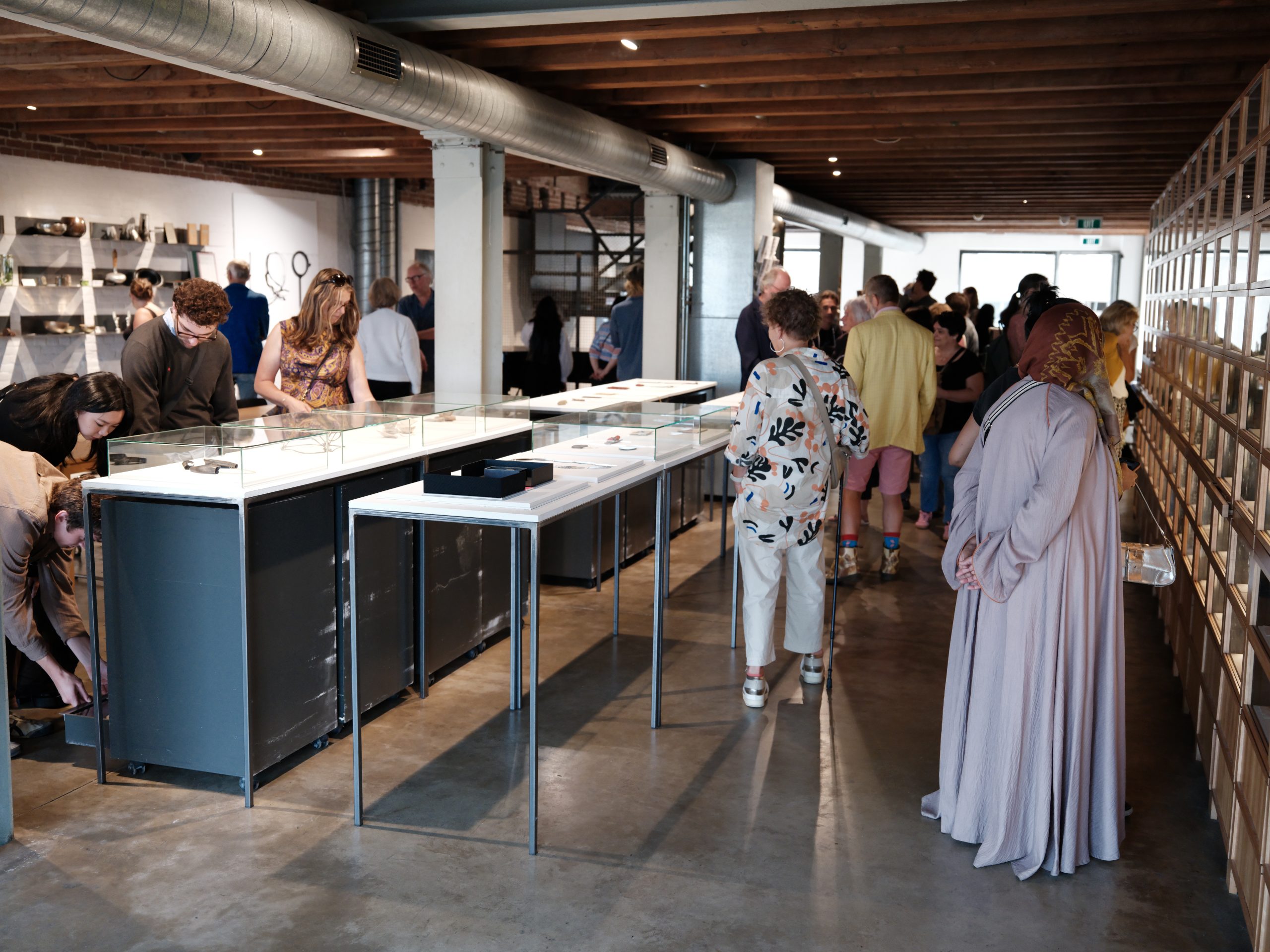
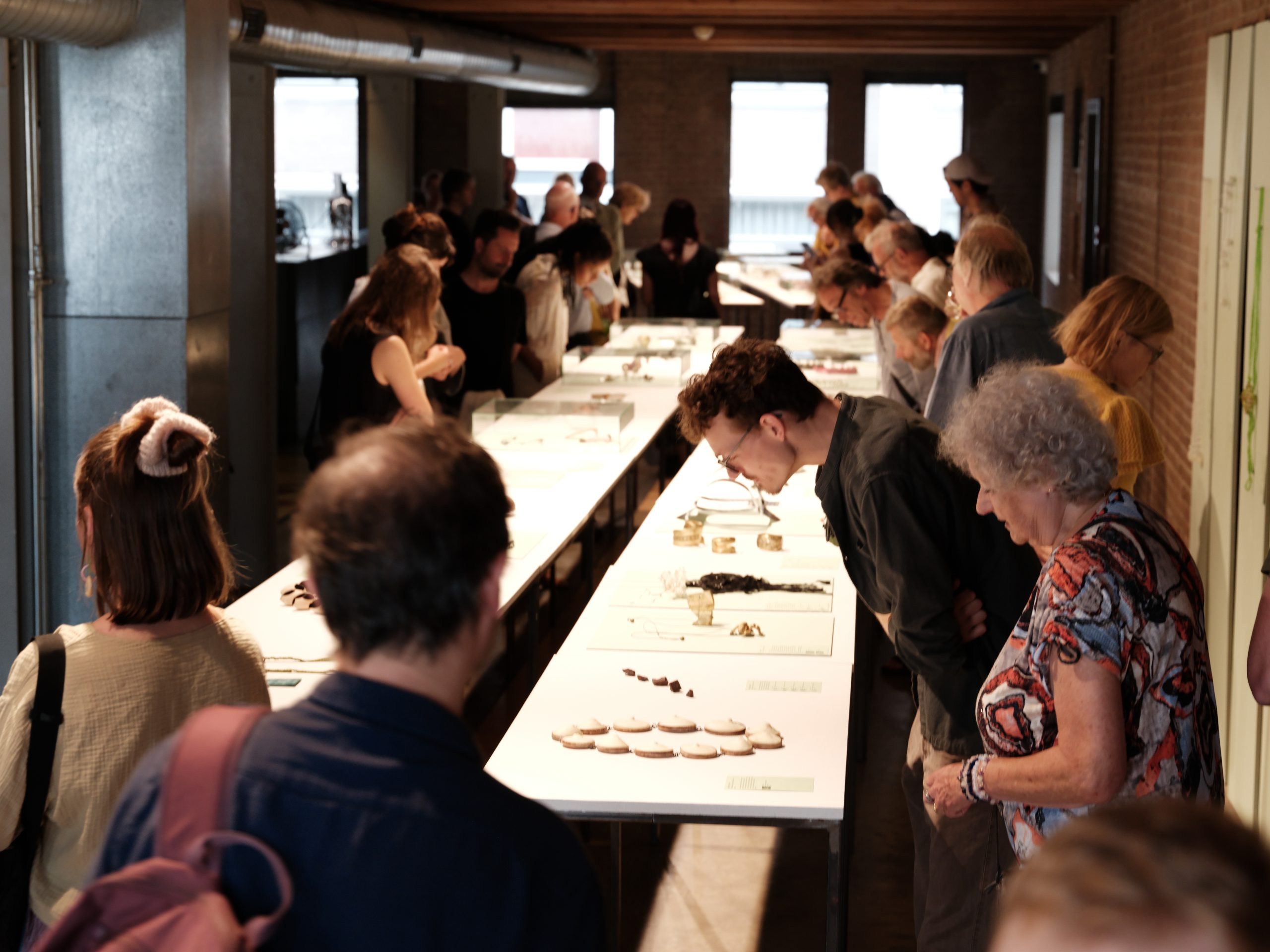
Held every year from August to October, the Marzee International Graduate Show is undoubtedly the highlight of our exhibition calendar and with it we aim to endorse the work of a new generation of jewellery artists; to increase their exposure to the wider public and to encourage a dialogue between makers and their wearers.
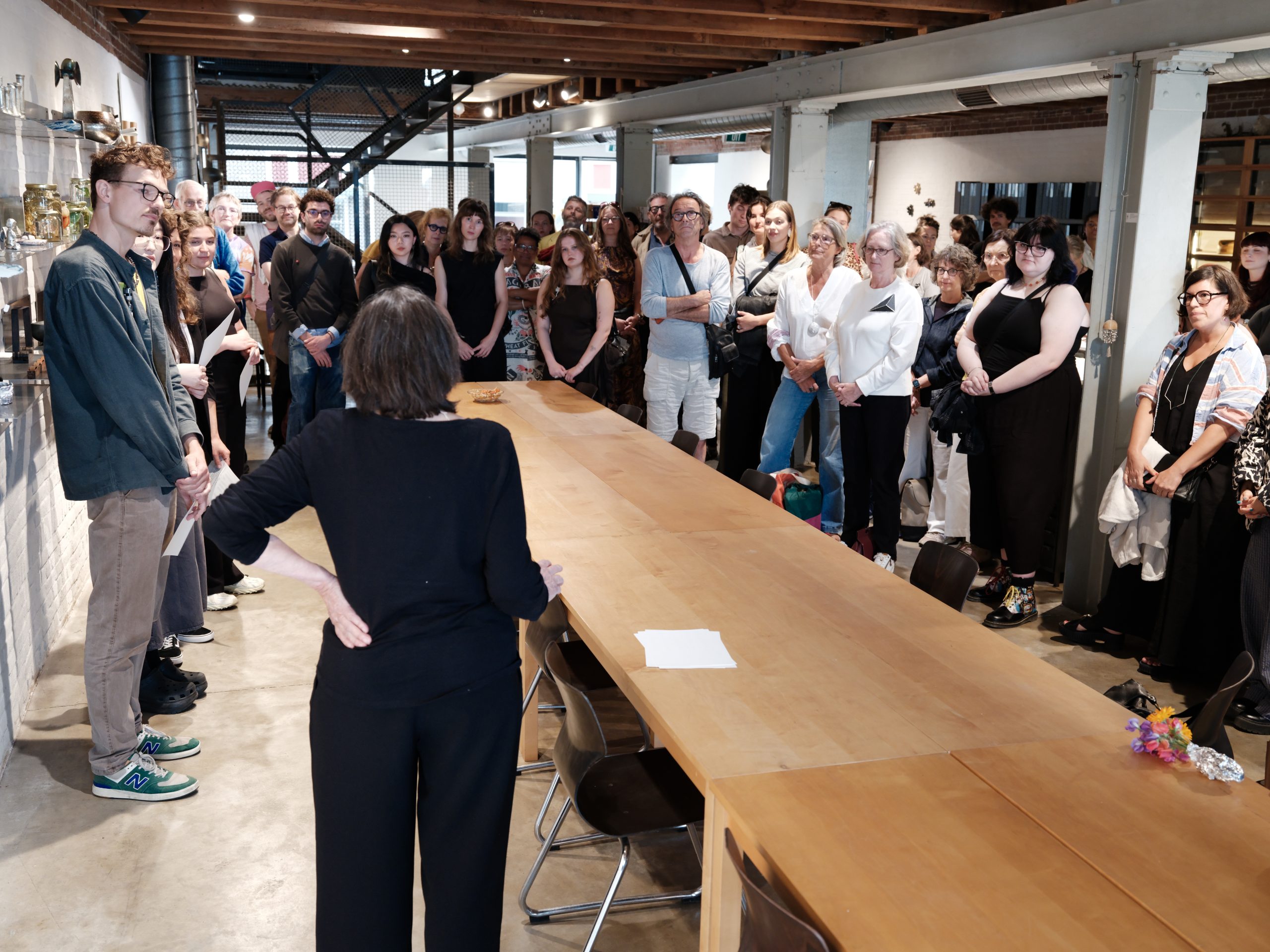
The first Marzee Graduate Show took place in 1986 and since then has grown from a modest exhibition to an event unparalleled in size and scope. Since 1995, the show has included students from a growing number of international schools and academies, providing a fascinating insight into the ideas and preoccupations that motivate young artists from around the world. Alongside the exhibition, we host a one-day symposium for participating graduates in which they have an opportunity to engage with their contemporaries and present and talk about their work, their inspirations, their aspirations, and the challenges that face them as they embark on a life outside of the supportive environment of a school.








This year’s recipients of the Marzee Graduate Prize:
Affo Bishara (BA) – Shenkar – Engineering. Design. Art., Ramat Gan, Israel
Esther Gleuwitz (MA), Akademie der Bildenden Künste Nürnberg, Nuremberg, Germany
Sonia Jurado (MA) – Escola Massana, Barcelona, Spain
Hyung-Chan Lee (MFA) – Kookmin University, Seoul, South Korea
Erik Lijzenga (MA) – Trier University of Applied Sciences, Idar-Oberstein, Germany
Joe Pillari (MFA) – State University of New York (SUNY), New Paltz, United States
Helena Renner (BFA) – Trier University of Applied Sciences, Idar-Oberstein, Germany
Miriam Strake (BFA) – Trier University of Applied Sciences, Idar-Oberstein, Germany
Hong Zhou (MA) – University of Applied Sciences, Düsseldorf, Germany
Not only is the opening of the final exam exhibition a melting pot of cultures and diverse views reflected in the works on display. Especially during the symposium – which is restricted exclusively to the final examination candidates – organised the day after the opening, is a moment in which all the different approaches, personal experiences and influences come together that ultimately led to the creation of their works. The final examination candidates in depth explain their work and together have a dialogue that sometimes leads to very theoretical reflections but even more often to very personal conversations. For many graduates, it also provides an insight into the working methods of various academies around the world and often leads to the choice of an onwards course elsewhere. As the symposium lasts all day, we fortunately also have time for a communal lunch and taking portrait photos like this ones below.

Jewellery is the art that allows me to express my creativity, give voice to my thoughts, emotions and makes it easier to express them externally. It’s also, a space of creative and artistic meditation where I can go back to working with my hands and leave screens and technology behind to reconnect with the beginnings of the wise craftsman. I see, jewelry as creative freedom, enjoyment and a way to question myself. A way to bring artistic creation to the street, to show art in an unexpected and authentic way. Moments of internal tingling prior to the creative moment, which are the trigger to take action and transform them into a piece. It is precisely this moment that is perhaps the most free, fresh and kind but also rational. Where everything is possible. A space with a continuous dialogue with me and a process of research to find that technique that allows me to make what is in my insight.
Mayfly, 2024
pendant; jade, porcelain, paper, brass, alpacca, thread
€1300

Why Do Pigeons Fly Home? contemplates ideas of home, identity and alienation in relation to Ireland’s intergenerational culture of emigration. While exploring this subject I became fascinated by the feathered inhabitants of Dublin and their resilience in a city that can be so unkind. I see similarities between Ireland’s youth and its pigeons, neglected and overlooked in the place they call home. My work doesn’t use the pigeon motif directly, instead I look to the remnants left behind to evoke a sense of emptiness, loss and longing that reflects the feelings experienced by those who choose to stay in an inhospitable home.
Feral Feathers, 2024
necklace; 925 Sterling silver, guitar string
€3600
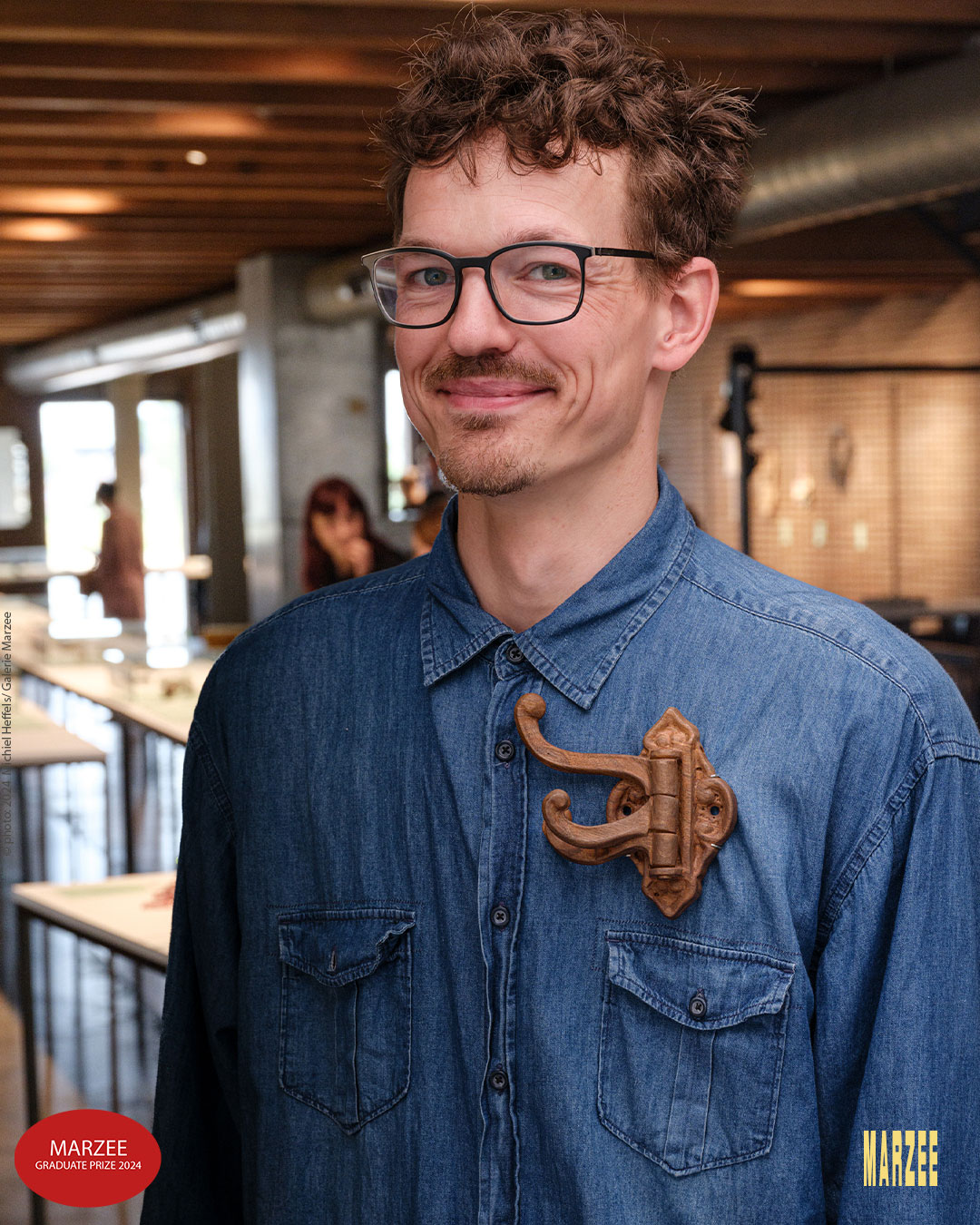
A diverse group of stone- and wood carvings, some which were made into wearable objects like brooches and pendants. My practice is based on found objects and revaluing what others might see as trash. The objects are found in the streets, in the gutter, are gifted to me, are found in thrift shops or flea markets or they find some other way in to my possession. The objects all have lived a previous life and they bear traces that tell of their experiences. I was driven to deeply explore these objects that almost seem to find their way to me on their own. In this process I felt the need to reproduce these objects by hand, as a way to understand them inside and out. Every detail was noticed and every imperfection was appreciated. Spending my time with these objects gave me a better understanding of how they function, how they were produced, where they came from, why they look the way they do. With these replicas I want to reinforce the value of handwork and craft while also making us more aware of the objects that play a role in our everyday lives.
Coathanger, 2024
brooch; American walnut, silver, steel
€1650

The graduate thesis by Svea Finck ‘Sorry, I got distracted – Artistic interpretation of the neurodivergence AD(H)D’ deals with various facets of the disorder and how it is perceived by those affected. It takes up the fundamental questions of the adornment, of a so-called disorder and deals with one of the elementary questions surrounding it. Where does personality and character end and where does neurodivergence begin? Svea shows jewellery in the graduate show that have to do with the condition and bear titles as: ‘My System Doesn’t Work but it Looks Cool’, ‘Maybe a Pile of Notes Will Give Me a Memory’ or ‘At Least I Remember It Was Important’.

Everything is process/ Creatures are not complete completed/ They wait/ they breathe/ they rest/ they incubate new/ What is coming is unknown and exciting electrifying exhilarating/ I want to be there when the new emerges/ Want to be part/ I am part/
As I interact with the creature-things we become entangled/ As matter transcends the familiar/ I realise the boundaries have always been unsharp/ Things wrap around explore feel our bodies/ free to detach uproot move on/ some are already gone/
By shifting away from the human-focused perspective of reading the world/ from the familiar the repressive the habitual and the prescribed/ I explore the potential for more free and more just/ different/ exciting/ rich/ enriching and deeply stimulating life/
Wherever you may go I will always be, 2023
necklace; experimental enamel, copper
€1850

In my practice drawing and jewellery making are inextricably entwined. Through the marriage of wirework and enamel I seek to transpose the gestural, instinctive qualities of my paper-based work into wearable objects. Emerging from an ongoing investigation into material and process, I create painterly and densely detailed surfaces by using traditional craft skills in unconventional ways. Milliners’ straw braiding techniques are applied to silver and copper wire, emulating the hand-drawn line. Elements from various enamelling methods such as cloisonné, champlevé and bassetaille are mixed and matched, to create a depth of colour reminiscent of translucent layered inks. Developed in tandem with a series of drawings and monoprints, my work is rooted firmly in the present, while also referencing a personal connection craft heritage. Taking metal and glass as my primary drawing materials, rather than pencil or ink, my graduate collection Unspool is a series of energetic sketches designed to be worn.
Beaded Necklace, 2024
necklace; copper, precious white metal, enamel, silk
€1500

„Drawn to organized chaos, this body of work explores the unique buildup and overflow that occurs within the jumble of a trash heap. Intrigued by the layered, squeezed, folded, and forced materials of haptically overfilled container, I find beauty and resolve in the raw and neglectful treatment for each discarded component for it to “fit in”. By freezing these cumbersome industrial waste bouquets that I craft in place, I honour the once loved materials that have been deemed useless or considered no longer valuable. Using recycled sterling silver, brass scraps from discarded projects in my refinement bin, spray paint, and lacquer I elevate the materials that were pushed aside in attempt to recreate the visual phenomenon of clutter that brings them back into focus.“
Scrap Bin Special, 2023
brooch; recycled brass, lacquer, stainless steel
€1625

Archetypal jewellery was made ubiquitous through clever advertising in a capitalist agenda. Its encounter with society is mediated through its presentation – information can be fabricated. I aim to investigate this dynamic of truth and power. My pieces pose as classical but I create subtle subversions through modifying gemstones – I reverse the process of facetting, heat treat different stones to appear the same and mix low value materials with high. Whether this is noticed is the point, what is revealed is left to the viewer – how aware are we in our consumption? Meaning can be switched from one that supports the leading narrative to one that upends its message.
Janus, 2024
locket; silver, rock crystal
€1750

Aamina Juma (BA) graduated from Central St. Martins: School of Art, London, UK
Aamina’s collection subverts our natural perceptions of jewellery. Precious metals and gemstones, traditionally denoting wealth, give way to wool, challenging our assessment of worth. Instead of the delicacy and sophistication of fine jewellery, Aamina employs a scale that takes her work into a playful, whimsical realm. Through her dramatic manipulations of material and proportion, Aamina invites us to reassess the role of jewellery and how we determine its value.
– Interpretative Text By Lance Chan BA (Hons) Culture, Criticism and Curation
The Locket, 2024
object; tufted New-Zealand wool, canvas, wool felt blend cloth, styrofoam, plastic, brass
€1900

Louane Schneider (DIPLOMA) graduated from Haute École des Arts du Rhin (HEAR), Strassbourg, France
Drawing on my memories, I create objects – material transpositions of moments, sensations and encounters.
The hand is at the heart of the process, gathering, welcoming, caressing, sculpting, then opening, revealing, offering and sharing. I am carving wood and drilling stones (and other materials) only with hand-tools, without using electricity. This allows me to work slowly, taking care of the material I choose to use, to have a more direct contact with it. The time spent sculpting charges the object with thoughts and memories – so as not to forget. Then the object passes into other hands – transmission and rupture – its meaning escapes. It opens up, welcoming new sensations for those who look at it, touch it, make it their own. I’m inspired by what’s around me : for the materials I choose (mostly from recuperation), from the discussions I have, tiny noises I could hear, the memories of precious moments I carry with me. Sound – especially tiny noises – in my work creates a link, another perception and is a way to express memories differently.
Talisman Sonore (Sound Talisman) n°3, 2024
object; wood, pebble
€2000

My father’s fish and chip shop has been a staple to our community for over 54 years. The shop, which previously belonged to my grandfather, has endured many financially difficult times. Today is no different. The current recession, commonly referred to as the cost-of-living crisis has resulted in immense economic instability. Cheap as Chips: Principles of a Fish Supper is representative of the fact that in today’s economy, a historically economical item such as chips is no longer ‘cheap’ or affordable. On the contrary, for many, they are perceived as a small indulgence. This rise in cost has a compounding effect on customers, ultimately altering the interaction between the people and the place. The fish and chip shop has become a place to visit occasionally rather than frequently.
Cheapest Chip, 2024
ring; 9ct gold plated copper, baltic amber, coral
€2300

In her thesis Is it Kitsch? Reinterpretation of mythological role models in jewellery and object Christina Quandt argues that ancient myths have turned into kitsch. While religious rituals have been lost, mythological role models have remained virtually unchanged through millennia of pictorial reproduction, with only minimal alterations. Although names and contexts may have changed, the respective roles of the figures have remained consistent. Quandt explores the roles of the “corrupted seductress” and the “holy virgin” in six resulting works.
Daphne, 2024
brooch; PLA (3D print), spring steel, polymer clay, lacquer, 23ct gold leaf
€1050

SECTION 333 is a collection of 33 pieces of jewelry made of materials fished out by me from a 333-meter section of the river bordering to The Oslo National Academy of The Arts. Their form is inspired by the illustrations of marine organisms from volume 3 of the book of Albertus Seba „Cabinet of natural curiosities: locupletissimi rerum naturalium thesauri 1734-1765”. Both the objects fished out of the water and the jewellery made of them represent the peculiar kind of „sub- naturalia” that perfectly fit the idea of Cabinets of Curiosities, popular in the 15th-16th century. My main topics include sustainability and process-based approach to material based artistic practice, ecology of nearby environments and the relationship between the nature and society, material self-sufficiency. The fieldwork method emphasise the performative, activistic and collective nature of my practice.
Ovula Ovum 02, 2024
brooch; aluminium, stel, hand painted with self made steel rust paint, copper
€850

Julia Boix-Vives (MA) graduated from PXL-MAD School of Arts, Hasselt, Belgium
Julia Boix-Vives explores the tensions between fine arts and the art of jewellery and objects by redefining the functions of ornamentation and the relationship to the body. Inspired by the universal ritual of a woman in front of her mirror, she creates a highly personal dreamlike universe where gesture becomes the principal character. In her creations, she uses beauty accessories such as makeup brushes, powder puffs, sponges and exfoliating nets, which she combines with metals and precious stones. Sometimes, she exploits the “extra plasticity” of a found object, drawing inspiration from its history and symbolism. Her jewellery and objects, invite the wearer to experience a poetic gesture. Julia also choreographs her jewellery in videos, perpetuating the vertiginous immersion of the ritual of the woman in front of her mirror.
Boîte à Rougir , 2024
necklace; garnet, brass, ruby, make-up puff and brushes, antique Sterling silver, enamel compact
€3250

Misha McLean (BA) graduated from Glasgow School of Art in Glasgow, Scotland, UK
Repeat Prescription focuses on our relationship with medicine. In the Western world, pharmaceuticals are undoubtedly intertwined in our daily lives. Medicine can be a life-saving tool but can equally cause harm to those who take it, resulting in many polarising opinions on this subject. Some see medicine as something that significantly improves their quality of life, allowing them to live without pain or discomfort. Some only take medicine when it is essential, as they are afraid of the adverse side effects. Some people see medicine as something valuable, precious and unattainable due to failing healthcare systems. Some see medicine as a way of “patching up” one’s problems, masking symptoms rather than addressing the root cause. Without medicine, some people would not be alive. I have created this collection to explore attitudes towards medicine in the Western world and encourage others to think about their relationship with prescription medication.
10mg, 2024
brooch; silver, steel, lacquer paint
€550

The title Liquilux is compounded from the latin words lique (melt) and lux (luxury). The collection is formed from materials that are used and consumed in the production of precious jewellery. By melting, carving and recontextualizing these functional materials into pieces of jewellery, a paradox is formed, creating questions about value and the industry’s historical hierarchy of materials. While Liquilux conjures imagery of modern functional substances; maybe something you would find in a hardware store, it also retains an archaic quality.
Sawtooth Accolade, 2024
brooch; beeswax, copper, steel
€1750

Aural waves ripple against our eardrum, and we become part of the surrounding acoustic horizon. Hearing extends beyond the ears, through the body, carrying a plethora of memories and emotions. When we listen, we make contact with the outside world but also with ourselves – hearing our own heartbeat or our inner voice. Our imagination reveals the hidden magic within sounds. Pressing our ear against a seashell we hear the murmur of the sea or we notice gentle whispers in the passing wind. Which sounds could silver earrings capture and which hidden or unexpected tonalities be revealed?
Inaudible Sounds II, 2024
ear piece; 999 silver
€1775

Tina’s jade pieces capture a fascination with the act of release, a transcendent moment where boundaries blur and the constraints of the stone dissolve into fluidity and motion.
By using techniques such as chain carving and “Devil’s Work Ball”, Tina illustrates this act of release while only using a single piece of jade for each item. The process represents vulnerability and strength; it requires courage to surrender, as one small mistake can damage the integrity of the work. However, it is through this act of letting go that the true artistic vision is achieved.
Devil’s Work Ball Ear Cuffs, 2024
earrings; serpentine
€1500 each